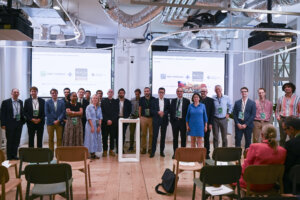


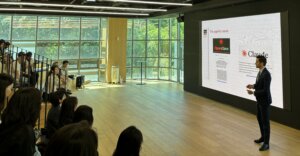
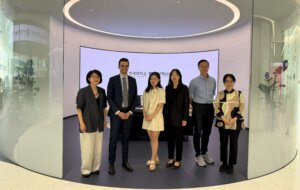
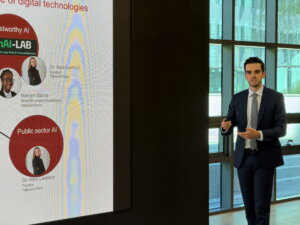
On June 23, 2026, Thomas Le Goff, an associate professor of law and digital regulation at Télécom Paris, spoke at Yonsei University (Institute for AI and Social Innovation) in Seoul as part of the seminar “Governing Agentic AI: Regulation and Sustainability in the Age of AI Agents.”
On that occasion, he presented the results of multidisciplinary research conducted at FinAI-Lab as part of the lab’s “Trustworthy AI” research area.
His presentation focused on recent technological developments in agent-based AI systems, highlighting the challenges they pose. The goal was to demonstrate how these highly autonomous systems differ from existing legal categories and to highlight the associated technical risks, particularly with regard to security, human oversight, and explainability.
The seminar also highlighted several major legal issues raised by the development of agent-based AI, including:
- the protection of personal data;
- the allocation of liability in the event of unexpected behavior or system failures;
- the environmental impact of these systems;
- and their regulation under the European Artificial Intelligence Act (AI Act).
Télécom Paris and the FinAI-Lab would like to thank Yonsei University and the Institute for AI and Social Innovation for hosting and organizing this seminar, which provided an opportunity to continue international discussions on the challenges of artificial intelligence governance.
We are pleased to announce our first research seminar on trustworthy AI, organized as part of the FinAI Lab, a joint research lab between BNP Paribas and Télécom Paris. It will take place on Thursday, May 28, from 11:00 a.m. to 1:00 p.m.
At this event, three researchers will present the latest developments in the following areas:
- Governing Agentic AI under EU Law: by Thomas LE GOFF, associate professor of law and digital regulation at Télécom Paris, and Nina LASBLEIZ, research engineer at Télécom Paris.
- Trust, Trustworthiness and Game Theory in LLM-Based Multi-Agent Systems: by Azzedine Idir AIT SAID, research engineer at Télécom Paris.
Do not miss this event, available for replay here:
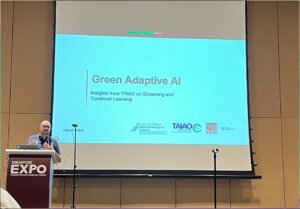
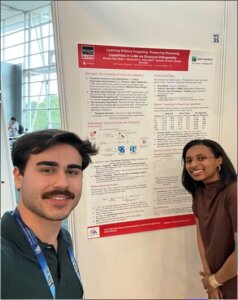
Albert Bifet, Mariam Barry, and Mustafa Hayri Bilgin participated in AAAI in Singapore. On this occasion, they presented three papers and a keynote.
In particular, they presented a paper titled “Learning Without Forgetting: Preserving Reasoning Capabilities in LLMs via Structural Orthogonality”.
Several members of FinAI-LAB will participate in ICLR 2026, which will be held in Rio de Janeiro, Brazil:
Mariam Barry (BNP Paribas, IT Group)
Yanlei Diao (École Polytechnique)
Rémi Grzeczkowicz (École Polytechnique)
Mehdi Mouayad (BNP Paribas, IT Group Production)
Amine Ouguenoune (BNP Paribas, IT Group)
Aude Rousseau (BNP Paribas, Compliance)
On November 26, 2025, Patrick Olivier, Director of Télécom Paris, Talel Abdessalem, Director of Research, and Sylvain Lamblot, Director of Partnerships, met with Marc Camus, Group CIO of BNP Paribas, and Olivier Osty, Deputy COO, to discuss the progress of the joint Télécom Paris–BNP Paribas research laboratory, FinAI-LAB.
The meeting was followed by a presentation by Mariam Barry and Winston Maxwell at BNP Paribas’ Scientific Digital Council (SDC), highlighting the achievements of the joint laboratory. The presentation underscored the importance of fostering state-of-the-art artificial intelligence research to support key banking functions, leveraging both BNP Paribas’ internal research expertise and partnerships with leading academic institutions such as Télécom Paris.
The Télécom Paris–BNP Paribas joint laboratory is currently recruiting postdoctoral researchers and CIFRE PhD candidates, in collaboration with laboratories at the Institut Polytechnique de Paris. Research activities are structured around five key areas: continuous and adaptable AI for large-scale infrastructures, foundation models for financial data, AI for cybersecurity, AI for fraud detection and AML-CFT, and trustworthy AI for financial institutions.
On July 8, 2025, Télécom Paris and BNP Paribas formalized the launch of FinAI-LAB (Trustworthy AI for Financial and Large-Scale Applications), a collaborative research laboratory dedicated to artificial intelligence in complex environments.
This laboratory aims to accelerate the development of robust and responsible AI solutions to address industrial and practical challenges in the financial sector, particularly in highly regulated environments where reliability, transparency, and performance are essential. It is structured around four research areas and a cross-cutting stream dedicated to trustworthy AI.
The first focus area is online and continual learning. It aims to design adaptive AI models and systems capable of continuously learning from evolving data streams, particularly those originating from dynamic and heterogeneous sources. The goal is to ensure that systems adapt robustly and dynamically to the variability of environments and information flows. It is led by Albert Bifet (Télécom Paris) and Mariam Barry (BNP Paribas).
The second research area, focused on cybersecurity, draws on behavioral and graph-based approaches to detect subtle intrusions that are often invisible to traditional tools. It is led by Rida Khatoum (Télécom Paris) and Frédéric Legac (BNP Paribas) and focuses on the cybersecurity of AI models, including the aspects of trustworthy AI and risk management.
The third research area, focused on foundation models for large-scale financial data, aims to leverage foundational modeling technologies to design architectures tailored to global financial data. The goal is to identify the key technological building blocks needed to build a foundational model specifically for financial applications. It is led by François Roueff (Télécom Paris) and Laurent Carlier (BNP Paribas).
The fourth research area focuses on the detection of fraud and money laundering using AI, particularly to identify suspicious patterns that elude rule-based detection tools and to generate explainable alerts. This area is led by Yanlei Diao from École Polytechnique, as well as Joseph Gesnouin Maarek and Aude Rousseau from BNP Paribas.
The fifth research area, which cuts across all the others, focuses on trustworthy AI. How can powerful AI tools be deployed within the highly regulated environment of financial institutions, where accountability and trust are paramount? This area examines the interplay between the European AI Act and regulations governing financial services, as well as issues regarding explainability, fairness, and legal liability. It is led by Winston Maxwell and Thomas Le Goff from Télécom Paris, along with Martin Pailhes and Léa Déléris from BNP Paribas.
The fifth research area, which cuts across all the others, focuses on trustworthy AI. How can powerful AI tools be deployed within the highly regulated environment of financial institutions, where accountability and trust are paramount? This area examines the interplay between the European AI Act and regulations governing financial services, as well as issues regarding explainability, fairness, and legal liability. It is led by Winston Maxwell and Thomas Le Goff from Télécom Paris, along with Martin Pailhes and Léa Déliris from BNP Paribas.
In line with open science principles, the laboratory also aims to actively contribute to the open-source ecosystem by sharing technological building blocks and methodological frameworks for the benefit of the scientific and industrial communities.